Understanding the method · Chapter 1
The method in ten minutes
Why most hiring is a gamble, and the five ideas that make it a decision instead.
In this chapter you will
The trouble with hiring
Most hiring starts with an advertisement and a pile of CVs. Somebody reads the pile, picks the people who look right, and invites them in. Each interviewer asks whatever comes to mind. Afterwards the panel compares impressions, and the most confident voice in the room usually wins.
Nothing in that process is written down before it starts, so nothing can be checked afterwards. Two candidates are rarely asked the same thing. A CV shows where someone has been, not what they can do. And the people who are best at interviews are not always the people who are best at the job.
The result is familiar. A hire that looked perfect on paper is gone within the year, and nobody can say what was missed.
The idea
HiMatcher turns the process round. You decide what the job needs before you meet anyone. You ask every applicant the same questions, chosen to show whether they can do those things. And you judge each answer against what you wrote down, not against the other candidates and not against a feeling.
People stay in charge throughout. The software keeps the method honest, does the clerical work, and makes sure nobody is lost between stages. HiMatcher has state-of-the-art AI built in, called Digital Nancy, used the way best practice says it should be: She drafts and she suggests. A person checks every draft and makes every decision.
Five ideas you will meet everywhere
The briefing. A hire begins with a conversation with the hiring manager: The person who will live with the result. Not "what is the job title?" but "what do you need this person to achieve, how will you know they are doing a good job in three months, and what will be different if they succeed?" HiMatcher records that conversation and turns it into words on a page.
The person specification. This is the single document a whole campaign runs on. It lists what the successful person must be able to do. Everything that follows is made from it: The application form, the scoring, the interview questions and the candidates you suggest to your client. Get the specification right and the rest is close to mechanical.
The criterion. Each line of the specification is a criterion: One thing the person must be able to do, together with the question that will test it and a description of what a good answer contains. You will take one apart in a moment.
The application form. Candidates do not send a covering letter. They answer the questions from the specification, in their own words, usually with one or two small tasks that let them show a skill rather than claim it. Every applicant answers the same form, so every applicant can be compared fairly.
The bands. A person reads each answer and places it in one of five bands, from Met all to Failed all, by comparing it with the description written in advance. There are no marks out of ten and no totals.
One criterion, taken apart
Northbridge Guitar School needs an administrator who will not let things slip. Much of the job is remembering that something must happen a set time after something else: A trial that ends after four weeks, a follow-up call ten days after a first lesson.
"Must be organised" would be useless. Everyone says they are organised. Here is how the specification puts it instead.
| Part of the criterion | What Northbridge wrote |
|---|---|
| Area | Organisation |
| Be able to | Run a set of tasks that fall due weeks after the thing that triggered them, without being reminded by anyone. |
| Question | A request for a specific example from a job they have held: What the tasks were and how many were live at once, the tool they used so that nothing was missed, what they did when something did slip, and how they would show someone today that nothing is overdue. |
| Criteria | Facts a reader can tick off: A real example, a number, a named tool, an honest slip and what they changed. |
| Where it is assessed | On the application form. Some criteria are kept for interview instead, because they need a conversation. |
Notice three things. The requirement is in the manager's own terms, not a personnel department's. The question asks for a particular past example and says exactly what to include, so a vague answer stands out at once. And the criteria are written as things an answer either contains or does not, so two people reading the same answer will reach the same view.
Why bands, and why no points
For every question on the form, the specification describes what each band looks like for that question. Reading an answer, you ask only one thing: Which description does this match?
| Band | Short name | In words |
|---|---|---|
| Met all | MA | The answer contains everything the criteria ask for. |
| Met most | MM | Nearly everything, with a gap that does not worry you. |
| Met some | MS | Part of what was asked for; real gaps. |
| Failed some | FS | An attempt, but it meets none of the criteria properly. |
| Failed all | FA | No answer, or nothing to the point. |
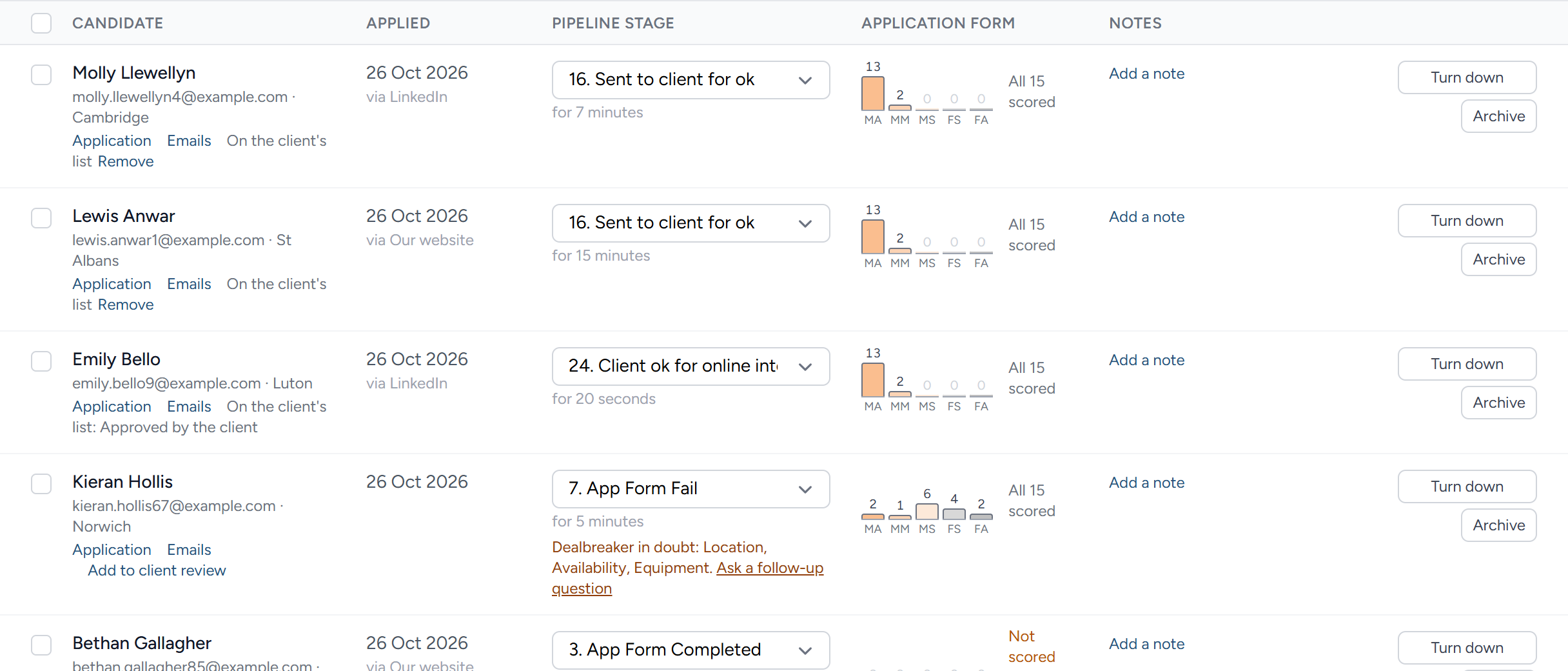
You will not find a score anywhere in HiMatcher. That is deliberate. A total hides what matters: Fifteen middling answers and a mixture of brilliant and hopeless ones can add up to the same number, and they are not the same candidate. So instead of a number, each candidate has a small picture: A pie chart on the scoresheet, and a bar chart in lists, showing how many of their answers fell in each band. A strong candidate is a picture that is mostly Met all. You can see it across a room.
What happens to a candidate
Everyone who applies moves through a pipeline: A list of stages from App Form Started to Start date confirmed. A few moves happen by themselves, when a candidate starts the form, submits it, or has it scored. Every other move is a person's decision, made with one click and recorded with who made it and when.
Along the way HiMatcher sends the emails that go with each stage, offers interview times for candidates to book themselves, records and transcribes interviews if you wish, and lets you suggest candidates to your client for their yes or no.
Where to go next
Take the quick tour. It follows the Northbridge campaign from the first questions to the client to the offer in about fifteen minutes, and shows you every screen on the way.
If a word in this guide is new to you, it is explained in The words we use.
This chapter was last revised on 30 October 2026.