Before anyone applies · Chapter 5
Questions we have for you
The plain facts the advertisement cannot be written without, asked beneath your briefing; the organisation chart beside them; anything the draft job description left open, answered in a line each; and what you have already told us, shown rather than asked again.
In this chapter you will
- give the plain facts, such as hours, pay and place, that every advertisement states
- send an organisation chart, a picture or a PDF, beside them
- see which of them you have already told us, and confirm or correct what we understood
- answer a question the draft job description could not settle without you
- know where each answer goes, until when you can change it, and when the part leaves your page
Two kinds of question
Beneath Your briefing on the campaign's page is the part for what the people running your campaign need to know from you. While your briefing is still yours to answer it sits directly under it, headed A few plain facts, so that the facts are given with the questions rather than after. Once the job description is drafted and has questions of its own it is headed Questions we have for you, and once the Person Specification is shared with you it moves down beneath that. The word beside its heading counts what is still open, 14 to answer say, or says All answered or Agreed.
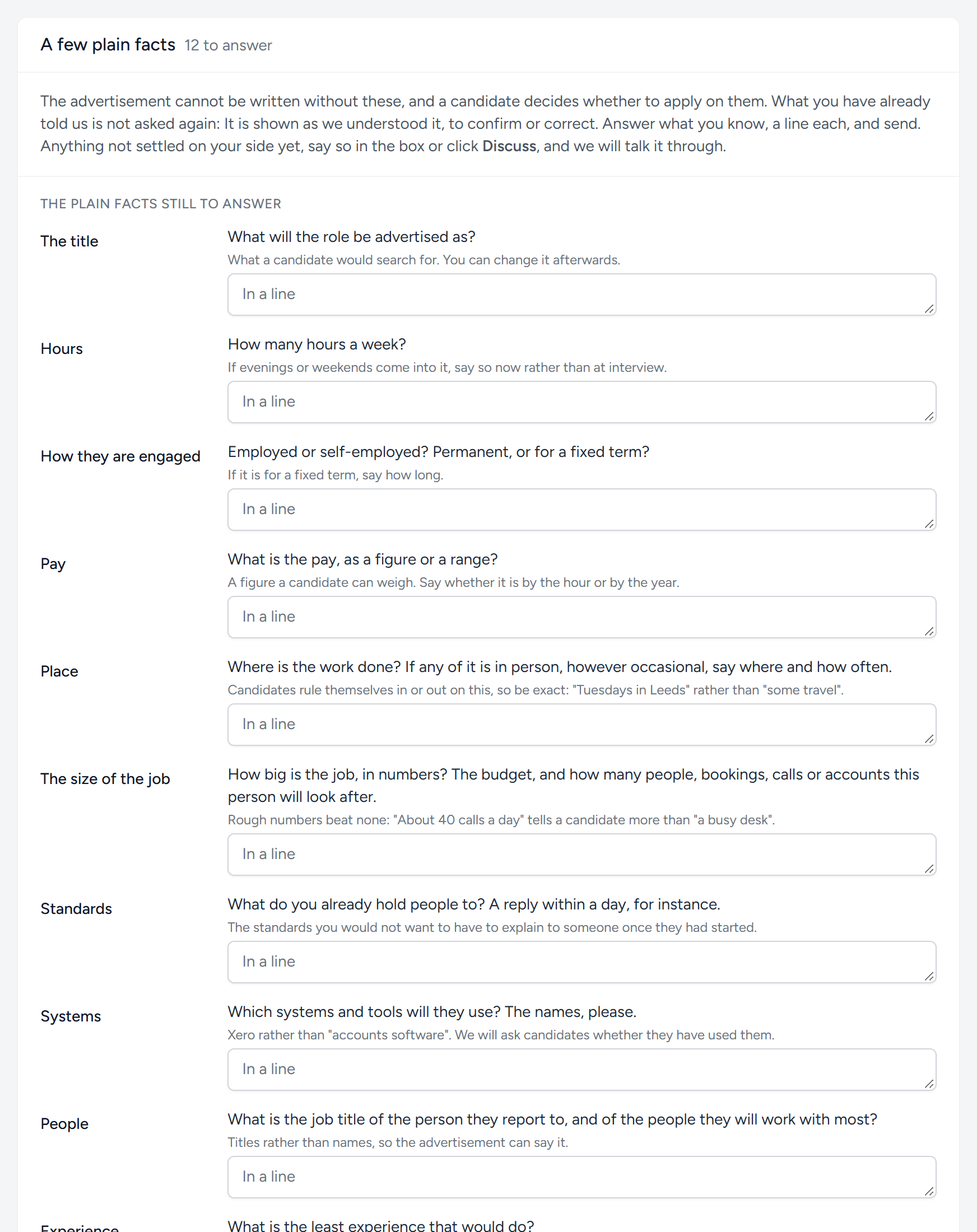
It holds two kinds of question, and one thing to send.
The plain facts. A candidate decides whether to apply on a handful of facts: What the role is called, the hours, how the person is engaged, the pay, where the work is done, the size of the job in numbers, the systems by name, who the person reports to, and so on. The advertisement cannot be written without them, and nobody guesses at them. Each has a line to answer in, with the question and a word beneath on what is wanted. A number is best wherever there is one: Not "near London" but "no more than three hours away". Answer what you know; anything not settled on your side yet, say so in the box or click Discuss, and it is talked through rather than guessed.
You are not asked what you have already told us. Before the facts are put to you, what you sent in writing, what you said in the briefing conversation and the Person Specification, drawn up from them, are read for them, and the part is in two halves: The plain facts still to answer first, and beneath them The plain facts we already have from you, each with the fact as we understood it and where it came from, "from your conversation with" your recruiter, say, with the words it rests on. Read those. If one is not right, click Not quite right? Correct it and give it in a line, and your line is what stands. Discuss beside a fact sends a note about it to the people running your campaign, for anything that needs more than a line. While what you told us is still being read, the part says so for a minute or two.
The organisation chart. At the foot of the facts you are asked for an organisation chart, a picture or a PDF, which says who reports to whom better than a line can, and it need not be tidy. Choose the file and click Send the chart. It goes to the people running your campaign with your other documents, and the part shows it with the day it was sent; Send a newer one adds another, and the earlier stays. If there is none, a few lines under People will do.
From the job description. When your recruiter drafts the job description, anything it needed and was not told is left as a question rather than invented. Those questions appear here, under From the job description, each with a box for your answer. A question about one of the plain facts is not repeated here: The fact's own line stands for it, and your answer there answers the description's question too. There may be none, in which case this heading does not appear.
Answering
Answer what you can and click Send your answers. A line each is plenty. What you leave blank stays open, and you can come back to it another day: The part keeps your answers and the count tells you what is left.
After sending, every answer is still yours to change. Change it and click Send the changes.
Where the answers go
The plain facts go to the people running your campaign as a document in your name, and they are emailed to say so. An answer to one of the job description's questions goes to a different place: It lands beside that question on your recruiter's side, marked as yours with the day, ready for them to put into the description. Once they have, the question leaves your page.
When they stand, and when the part goes
Once the job description is agreed, the part says Agreed and the answers stand. Nothing on it can be changed from then on; to raise anything, write to one of your contacts at the foot of the page.
The questions are there for writing the advertisement. Once it is live, or the campaign has moved on to applications, suggested candidates or interviews, the part has done its work and leaves the page: What you answered is in the advertisement, which you can read under What we agreed. Your recruiter may also take the part from your page sooner, for instance where a colleague of yours answers these questions instead. If it is not on your page, nothing is waiting on you.
This chapter was last revised on 30 October 2026.